In an old ponderosa pine forest, the trunks are hard to miss: thick bark, yellow to orange-red, broken into broad plates with black cracks between them. Some people say a furrow of that bark smells of vanilla. Others smell nothing at all. Either way, the bark is what has kept these trees alive for centuries.

A tree made for fire
Ponderosa pine grows from southern Canada into Mexico, and from the Great Plains to the Pacific coast. Grown trees are commonly 27 to 40 metres tall, and they often live 300 to 600 years.
For most of that history, fire was a regular visitor. Low surface fires swept through most ponderosa forests every 5 to 20 years, keeping them open and park-like. A big tree's thick bark protects it from those fires. A seedling has no such armour, and fire easily kills it.

The armour comes early. A young ponderosa starts growing insulating bark once its trunk is about 5 centimetres thick, enough to survive most low fires. In Oregon's Blue Mountains, saplings that size already had 3 to 6 millimetres of protective outer bark, while white firs twice as wide still had thin, green bark. On old trees the plates can be 7.5 centimetres thick or more. Ponderosas also shed their lower branches, so a ground fire has less to climb. A stump section collected near Bly, in Klamath County, in 1937 had rings running from 1255 to 1930, marked with fire scars along the way.
The needles are long, 15 to 24 centimetres in the Pacific form of the tree, and grow in bundles of three. The cones are 8 to 15 centimetres long, and their seeds feed mice, chipmunks, squirrels and many birds. Deer and elk shelter in the forest.
An open forest of big trees
A good record of what these forests looked like in south-central Oregon comes from timber surveys of the Klamath Indian Reservation in 1919 to 1922. In the pine stands, ponderosa made up 96% of the trunk area, and big trees, over 53 centimetres across, made up four fifths of it. When unlogged stands were resurveyed in 1997 to 2006, there were three times as many trees, and in the pine stands the big ones made up only about a quarter.
Farther north, in central Oregon, some pine stands went from 20 to 50 trees an acre in the 1910s to 500 to 1,000 by the 2000s. That is the difference between a tree every 9 to 14 metres and one every 2 or 3. In stands like that, young firs grow up under the pines like a ladder, and a fire that once stayed on the ground can climb into the crowns.
Timber, and a forest that changed hands
Ponderosa is one of the West's main timber trees, and in the Klamath Basin that shaped history. The Klamath Tribes describe their reservation forest as "the largest remaining stand of Ponderosa pine in the west." Those pine stands were one of the draws when Congress terminated the tribes in 1954, and 700,000 acres of the forest became the Winema National Forest. The tribes regained federal recognition in 1986, but not the land.
That forest is now part of the Fremont-Winema, where much of the Bootleg Fire burned, in the Klamath Tribes' traditional territory. The tribes are among the partners in the plan for replanting it.
Back into burned ground
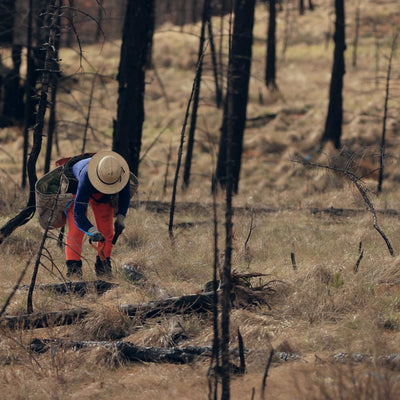
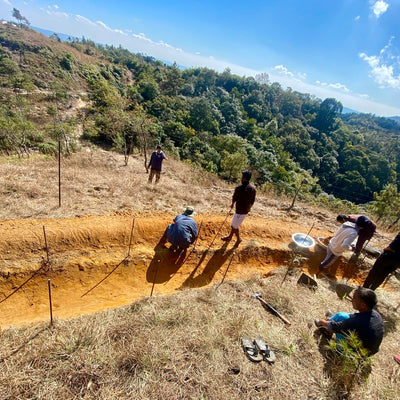
In July 2021 the Bootleg Fire burned 413,765 acres of southern Oregon, the third largest fire in the state since 1900. That is where Greenr Gifts trees in Oregon were first planted, with American Forests. Our planting reports from there list ponderosa pine, lodgepole pine, western larch, white fir and Douglas fir.
Ponderosa leads by far. Across the three Oregon plantings our trees have been part of, in May 2025 and April 2026, crews planted 129,162 seedlings, and 82,928 of them were ponderosa pine. That is about two in every three.
It suits open, burned ground: it needs full sun, and within months of sprouting a seedling's roots can reach 50 centimetres down in loose, moist soil. The post-fire plan aims for enough fire-resistant conifers on the land, growing fast enough to survive the next fires, with thick bark and branches that prune themselves.

Seedlings are the stage fire kills most easily. The trees that get past it can live for 300 years or more.
More about ponderosa pine, or see the Oregon project.
Sources: USDA Forest Service, Silvics of North America, "Ponderosa Pine"; USDA Forest Service, Fire Effects Information System, "Pinus ponderosa var. benthamiana, P. p. var. ponderosa" (including Hagmann et al. 2013 on the Klamath Reservation surveys); USDA Forest Service photo record, stump section, Deming Creek, Bly (1937); The Klamath Tribes, "History"; William G. Robbins, "Termination", Oregon History Project (2002, revised 2014); Robert Donnelly, "Winema National Forest", Oregon History Project (2003); Gillian Flaccus and Nathan Howard, AP, "Fires threaten Indigenous lands in desiccated Northwest" (July 2021); American Forests and partners, South Central Oregon Integrated Post-Fire Resilience Strategy (July 2023); "Pinus ponderosa" and "Bootleg Fire", Wikipedia; Greenspark planting records for the Bootleg Fire recovery area (May 2025) and Boulder (April 2026). Top photo: Vlad & Marina Butsky, CC BY 2.0, via Wikimedia Commons.