A mangrove forest on the Kenyan coast isn't one mix of trees. It grows in bands, and each species has its own. One band belongs to the loop-root mangrove. Just landward of it, on mud the tide floods less often, is a band of smaller trees with light green, round-tipped leaves. That is Ceriops tagal, the spurred or yellow mangrove, called mkandaa in Swahili.
Made for salty mud
That mud is a hard place to grow. It floods less often, and evaporation can leave the soil very salty. The spurred mangrove copes. In its own zone it often stays small, a shrub or a tree of about 4 metres, with a flared base and short knee roots poking up from the mud.
It also starts its seedlings early. The seed sprouts while the fruit is still on the tree, and the seedling grows a slim stem, up to 35 centimetres long, while it hangs from the branch.

The salt slows it down, but it holds its ground. At Gazi Bay, about 50 km south of Mombasa, Kenyan scientists measured how much new wood each band of the forest adds. The spurred mangrove band added about 2 tonnes a hectare a year above ground, less than a third of the loop-root band beside it. Yet it was the commonest tree in the stretch they studied, 29 of every 100 stems, and across the forest 41 of every 100 young saplings coming up were spurred mangrove.

Flowers that open at night
From Kenya to Mozambique, the spurred mangrove flowers mainly from November to March, so the trees along the creeks are coming into flower now. The flowers are tiny, about half a centimetre, and open mostly in the evening with a faint, sweet scent.
The petals hold the pollen under tension. When an insect probes the flower, the pollen bursts out over it, to be carried to the next tree. Small night-flying moths are thought to be the main visitors, and bees call by day. Mangrove flowers feed honeybees on this coast too, and EarthLungs has put up beehives at Mteza Creek.
Poles, planks and dye
People on the coast have long used it. Its poles grow long and straight, and the Giriama people of Kenya prefer them for building houses. The wood goes into small planks for boats, paddles and fishing stakes, and into firewood. The bark is rich in tannin. It has been used for tanning, for a reddish-brown dye, and to keep fishing nets and sails from rotting.
In a traditional house, the spurred mangrove does the fine work. Around Mida Creek, north of Mombasa, a study in 2000 found thick loop-root poles used for the posts and corner pillars. The thin spurred mangrove poles, called fito, are tied across them in a lattice for the walls and roof, and the lattice is packed with clay or coral stone. One house took about 1,000 fito. About nine in ten village houses there were built this way, and a house lasted about eight years, so the poles were always needed again. Over-cutting, for poles, timber and firewood, is the main reason East Africa's mangroves have shrunk.
It grows wild far beyond Kenya, from East Africa across the Indian Ocean and tropical Asia to Australia and the Pacific.
In our Kenya plantings
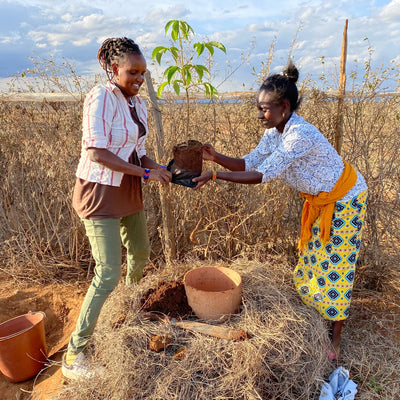
On our planting record, 13 of the 15 Kenya plantings name spurred mangrove on the day shown. At Vanga on 14 October 2025, 100 planters put in 110,000 of them. At Chara on 11 May 2026, 72 planters put in 107,800.
Counted seedling by seedling, its share is even larger. The planting reports for those 15 plantings log about 2.27 million mangroves, and just over 2 million of them, close to 9 in every 10, were spurred mangrove. The sites run more than 250 km up the coast, from Vanga by the Tanzanian border to Chara in the Tana River delta, and one batch went in across the border in Tanzania.
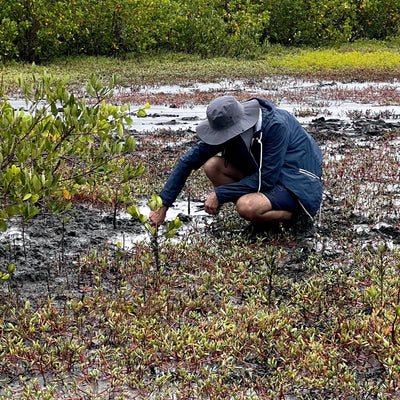
At Mteza Creek, the EarthLungs team picks seedlings off grown trees and pushes each one straight into the mud, about a third of its length deep, roughly one every two steps. That is around 5,000 a hectare. At that spacing, 2 million seedlings would cover about 400 hectares, some 560 football pitches.

More about the spurred mangrove, or see the Kenya mangrove project.
Sources: D. Gillikin, "Ceriops tagal", Union College mangrove guide; PROTA, "Ceriops tagal", via PlantUse; Githaiga, Kotut, Kariuki & Kairo, "Structure and biomass accumulation of natural mangrove forest at Gazi Bay, Kenya", Bonorowo Wetlands (June 2020); Kathiresan & Bingham, Biology of Mangroves (2001); Dahdouh-Guebas, Mathenge, Kairo & Koedam, "Utilization of mangrove wood products around Mida Creek", Economic Botany (2000); Greenspark, "Uplifting impoverished communities through mangrove restoration"; Greenr Gifts planting record (Greenspark planting records for Kenya, 2025-2026).