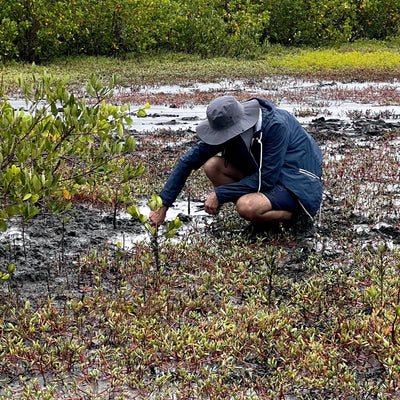
Mangroves can only grow where the tide reaches them. At Mteza Creek near Mombasa, silt washed down from hillside farms had smothered the old mangroves and choked the flow of the tide. So before the EarthLungs team plants a single tree, they dig.

Why the old mangroves died
Around the world, mangroves grow on gently sloping mud that the tide covers about 30% of the time or less. Flood them more often and they drown. Cut them off and the mud dries out and turns salty, and the trees suffer as they would in a drought.
At Mteza the trouble came from upstream. Inland, farmers tilled steep hillsides without terraces, so heavy rain carried soil down into the creek, and the floods of 1997-98 brought a huge load at once. The tide spread sand over the clay mud and buried the short breathing roots that grey mangroves push up through the mud to take in air. With those roots covered, the trees suffocated.
Mteza wasn't alone. At Mwache Creek nearby, about 200 hectares of mangroves died after the same floods, an area of some 280 football pitches.
How a trench brings the tide back
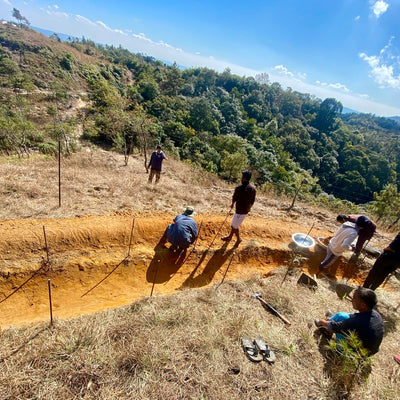
The trenches work like small creeks. At Mteza, long raised mounds run in rows with narrow trenches between them, and one bigger, deeper trench runs across the ends of all the rows. The deepest is about 60 centimetres, roughly knee deep. As the tide rises, seawater runs in along the trenches. As it falls, the water drains out again, so it doesn't sit and go stale, and salt doesn't build up in the mud.

The mounds matter as much as the channels. They are made of the clay dug out of the trenches, which is richer than the sand on top, and the young grey mangroves are planted on them, up out of the sand that killed the old forest.
Veritree explains why trenches matter, filmed on the Kenyan coast (July 2026).
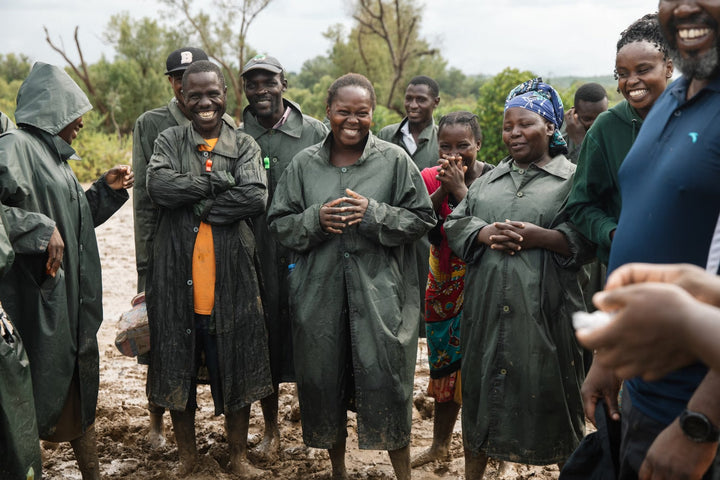
About 100 people from the nearby villages spent three weeks digging trenches and building low mounds. Now the tide flows in and out again, and young mangroves go in along the trenches and on the mounds.

Along the Kenyan coast, EarthLungs has now dug more than 100 km of trenches. Mteza has the longest network of all, over 30 km, about three-quarters of the length of a marathon.
Each species at its own height
How often the sea covers a patch of mud, and how salty it gets between tides, decides which mangrove can live there. Scientists measured this at Gazi Bay, about 50 km south of Mombasa. The white mangrove grows on the seaward edge, where the tide covers it most. Behind it comes the red mangrove on its stilt roots, then the spurred mangrove, and last the grey mangrove, which the sea reaches only at the biggest tides. From the lowest band to the highest, the ground rises less than two metres, about a person's height. Over that short climb the water in the mud goes from about 30 parts of salt per thousand, a little less than the sea's 35, to 48. In the grey mangrove band, salt crystals form on the mud after the spring tides drain away.
At Mteza the planting follows the same logic. The grey mangrove, a tough pioneer, goes on the mounds. The red mangrove was the first species planted here, and white mangroves grow wild.
The trees can even show where the tide used to run. On one inspection before planting, at a site the account doesn't name, EarthLungs found wild white mangroves far up from the water, well outside their usual band. The patch, they learned, had once flooded regularly, until silt and fallen trees dammed the channel that carried the high tide in.
Reading the water wrongly is costly. In Sri Lanka, a study of 23 mangrove planting projects found nine with no surviving plants at all. Seedlings planted at the wrong height often ended up in the wrong soil.

Once the water moved again, life followed it. Read about the crabs, fish and flamingos now back at Mteza, and the people who work there.
Mteza is one of the EarthLungs sites where Greenr Gifts mangroves are planted: more than 6,500 so far along the Kenyan coast. See the project.
Sources: Climate Action Now, "The Hydrological Interventions of Mteza" (May 2026); EarthLungs, "Transforming Mangrove Restoration Through Trenching" (2025); Veritree, "Why We're Digging Trenches To Plant Mangroves" (video, July 2026); KEFRI, Mangrove Deaths in Kenya (2023); Rufford Foundation, Mwache Mangrove Forest Regeneration (2017); Lewis, Ecological Engineering (2005); Githaiga et al., KMFRI, Bonorowo Wetlands (2020); Dahdouh-Guebas et al., Bulletin of Marine Science (2004); FAO, survey of the Kenyan coast (1986 data); Kodikara et al., Restoration Ecology (2017).