In the mangroves of Primeira Cruz, some of the clearest signs of recovery come from the animals.
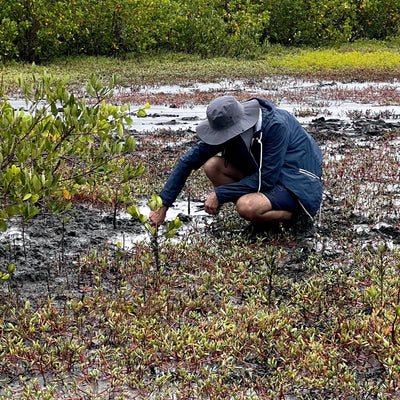
The mangroves here were cut for charcoal and cleared for salt pans. As SamaÚma replants them, wildlife is moving back in. In April 2025, Veritree reported that manatees had returned to the area, a sign that the water and habitat are getting healthier. Crabs, which local fishermen rely on, had become more plentiful.
A sea cow that grazes the mangroves
The manatee on this coast is the Antillean manatee, the sea-going kind. Adults can grow to 4.5 metres long and weigh 600 kilograms, about as much as eight grown people. They graze slowly on algae and seagrass, and also on mangrove leaves and riverside plants.
Brazil lists the species as endangered, and a 2010 study called it the country's most threatened aquatic mammal. Along this northern coast, hunting once wiped manatees out of some places altogether. Today the main dangers are fishing nets and the loss of quiet estuaries to building and clearing along the shore.
Researchers say this part of Maranhão suits them because the big tides spread water over wide, sheltered flats, with plants to eat and places to hide. In the early 1990s, surveyors found manatees around Baía do Tubarão, a little way along the coast from Primeira Cruz, and from 2003 Brazil's wildlife agency, ICMBio, watched them at Ilha do Gato in Humberto de Campos, the neighbouring municipality. That work stopped when ICMBio closed its Maranhão base in 2015. Since then, nobody has known how the state's manatees are doing, which is why reports like Veritree's matter.

Crabs that live on fallen leaves
The crab that matters most here is the caranguejo-uçá, a large mangrove crab and one of Maranhão's main catches. It lives in burrows in the mud and eats the leaves and seedlings that fall from the trees. In neighbouring Pará, researchers found the crabs ate about four-fifths of everything that fell, so more trees mean more food for crabs. Catchers say the best crabs are found under the red mangrove, one of the three mangrove species SamaÚma plants here.
Most crabs are caught by hand. At low tide the catcher reaches an arm deep into a burrow and pulls the crab out. A study of crab catchers between 2006 and 2010 found men from São Luís travelling by motor boat to Primeira Cruz to work its mangroves.
In the rainy months the crabs leave their burrows to mate, for two or three days at a time around the lowest tides. The males foam at the mouth, and locals call it the "andada", the walk, or simply carnival. Catching is banned then. In 2026 the closed periods in Maranhão ran through February and March, and registered catchers can receive a government payment while they wait.
The red bird comes back
The scarlet ibis, a bright red wading bird that thrives in healthy mangroves, is recovering too. In a report from its visit early in 2026, Veritree said staff were seeing more birds around the restored areas. The community hopes to offer birdwatching tours once the forest has grown back.

The ibis's colour comes from what it eats. In a mangrove in southeast Brazil, crabs made up 95% of the prey ibises caught, mostly small fiddler crabs pulled from their burrows. Chicks hatch with black down and take about 18 months to turn fully red. They nest in trees, in colonies, and can fly 60 to 70 km between where they feed and where they roost.
The bird was once called the most common waterbird of the Amazon region, and its range in Brazil reached as far south as Santa Catarina. Today, in Brazil, it is found mostly along the coast between Amapá and Maranhão. The threats researchers name are hunting, the taking of eggs and nests, and the cutting of mangroves. Every patch of mangrove that grows back on this coast is more ground for crabs, and more crabs mean more food for the ibis.

Sources: Veritree, "Restoring Mangroves and Hope in Maranhão" (April 2025) and "Restoration Progress in Maranhão, Brazil" (March 2026); Conceição et al., Revista Brasileira de Zoociências (2020); Luna et al., Arquivos de Ciências do Mar (2010); Terceiro, Santos & Correia, Revista de Administração e Negócios da Amazônia (2013); Nordhaus, Wolff & Diele, Estuarine, Coastal and Shelf Science (2006); O Imparcial (March 2026); Greenspark, "Rebuilding Brazil's Coastal Forests With Mangrove Restoration in Maranhão" (February 2025); Olmos, Silva & Prado, Waterbirds (2001); Oliveira, Boletim do Laboratório de Hidrobiologia (2003); Smithsonian's National Zoo, Scarlet ibis (read November 2026).